Short answer: Most modern metal warehouse roofs can take solar panels. Before anyone orders kit, though, you need to know that the structure can carry the load, the roof will outlast the panels, and the grid will accept the connection. These are the nine checks we make on every warehouse, factory and industrial unit.
Key facts
- Profiled metal (trapezoidal) sheeting is the most common industrial roof, and it’s usually the simplest to fit.
-
We don’t fix panels straight onto asbestos.
-
G99 approval typically adds 8–12 weeks before installation, so start it early.
- A 50–150 kWp system usually takes 1–2 weeks on site.
1. Structural capacity
Can the roof carry the extra weight, plus wind and snow loads? Modern portal-frame buildings often have spare capacity, but you can’t assume it. On larger systems, we arrange a structural assessment. Lightweight mounting helps. On profiled metal roofs we use systems such as Renusol MetaSole+, which fixes directly to the sheet profile with minimal added weight and no need to go through into the purlins.
2. Roof age and condition
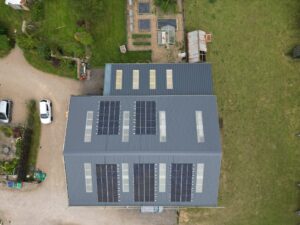
Panels last for decades. If the roof will need replacing in the next few years, it’s far cheaper to find that out now than to lift and refit an array later. Look for corroded sheets, failing fixings, cut-edge corrosion and leaking laps. Sometimes the best answer is to re-clad and fit solar as one job. That’s what we did on a farm store at Little Habton, with a new trapezoidal roof, solar and a battery.
3. What the roof is made of
- Trapezoidal steel or composite panels: usually ideal. We use mounting suited to the profile, including Kingspan KS1000-type composite sheets.
-
Corrugated sheets: usually fine with the right fixings.
-
Fibre cement: needs care. Older sheets may contain asbestos, and some can’t take foot traffic or fixings. We don’t fix onto asbestos. Instead, we over-clad the roof and fit the solar on top, as one job.
- Flat or membrane roofs: usually ballasted. See our guide to ballasted flat-roof solar.
4. Orientation and shading
South-facing roofs give the most in the middle of the day. East/west roofs spread generation across the morning and afternoon, which often suits a working site. Check for shading from taller buildings, plant, parapets or trees, and for things on the roof itself such as vents, extract fans and rooflights.
5. Rooflights and safe access
Rooflights are a fall risk and take up space. We design around them and protect them while we’re working. Think about access too, now and in future. Scaffold, edge protection and lifting all need planning, and on some roofs a permanent lifeline is worth fitting so the array can be serviced safely. On a warehouse in Oldham, we fitted a permanent 72 m Soter II Man-Safe lifeline.
6. Your electrical supply
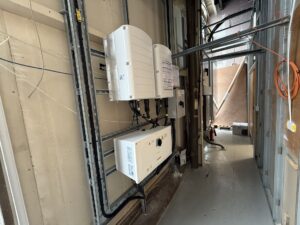
Most industrial systems need a three-phase supply with room in the main distribution board. We check the incoming supply, the board and the cable routes from roof to plant room. On multi-unit sites, each unit may need its own system. At Oldham, each of the seven units has its own system, inverter and meter.
7. Grid connection (G99)
Commercial systems almost always need G99 approval from your network operator. We prepare and submit it, with the technical details and diagrams the network operator needs. If the network operator limits export, we design around it with export limitation, a battery or both. See G99 applications and the G99 timeline.
8. Lease and landlord
If you lease the unit, you’ll need the landlord’s consent before work starts. Landlords usually want drawings, structural information, insurance details and to know what happens at the end of the lease. A PPA can work for both sides. See also solar PPA or buy outright?.
9. Insurance and planning
Tell your building insurer about the installation. We provide the documentation they usually ask for. Most rooftop systems on industrial buildings fall under permitted development, but there are limits, so check for listed buildings, conservation areas or conditions on your planning consent.
In practice: an occupied site, working around the business
At Middlewich, we fitted solar across four units, with four separate grid connections commissioned on 21 February 2025. At an occupied industrial estate in Peterborough, we installed 300.06 kWp on flat roofs across three units, with three grid connections, while the units stayed in use. Planning access, deliveries and isolations around the occupiers is part of the job.
What it costs
Typical commercial prices run from about £28,000–£37,000 for 50 kWp to £50,000–£65,000 for 100 kWp, excluding VAT. Larger systems fall to around £420–£650 per kWp. See how much commercial solar costs.
Frequently asked questions
Can my warehouse roof take solar panels? Most modern metal roofs can, but we always check the structure and condition first. On larger systems, we arrange a structural assessment.
Do solar panels damage a metal roof? Not when they’re fitted properly. Mounting designed for your sheet profile keeps the roof weathertight. Some systems fix to the sheet and don’t need to go into the purlins.
What about an asbestos roof? We don’t fix panels straight onto asbestos. We over-clad it and fit the solar on top, as one job.
How long does installation take? Usually 1–2 weeks on site for a 50–150 kWp system, after G99 approval. G99 typically takes 8–12 weeks.
Get your roof checked
Send us the address and a recent electricity bill. We’ll do a desktop check of the roof and orientation, then survey the structure, condition and supply in person.
Book a free survey · Call 01482 765063
Related guides: Warehouse and industrial solar · Ballasted flat-roof solar · Commercial solar panel cost