
Solar PV for Warehouses, Factories and Industrial Units
Large roofs, steady daytime demand and a three-phase supply make industrial buildings some of the best places to install solar. BrightEdge Solar designs and installs commercial rooftop PV and battery storage for warehouses, factories, workshops and industrial units. We handle the roof checks, the grid application and the installation, working around your operations. We’re based in Beverley and install across the UK.
Why industrial buildings suit solar
- Daytime demand. Lighting, machinery, compressors, refrigeration and offices draw power during the day, when solar generates. Power you use on site saves you the full price you’d otherwise pay for it.
- Big, simple roofs. Large pitched or low-pitch metal roofs leave room for a sizeable array, and installing on them is straightforward.
- Existing three-phase supply. Most industrial sites already have the connection a commercial system needs.
- Cost certainty. Once installed, the energy your panels generate isn’t exposed to future price rises.
We base the system design on your actual consumption, not the biggest array the roof will hold.
Roof types we work with
Profiled metal (trapezoidal) sheeting is the most common industrial roof. We use mounting systems designed for these roofs: Renusol MetaSole+, which fixes directly to the sheet profile with minimal added weight and no need to penetrate the purlins, and suits trapezoidal, Kingspan KS1000 and corrugated steel sheets; or Clenergy rail on trapezoidal roofs. Rooflights are worked around, and protected while we’re on the roof.
Fibre cement roofs need care, because older sheets may contain asbestos and some can’t take foot traffic or fixings. We’ll assess the roof and talk you through the options. Where a fibre-cement roof is suitable, we use hanger bolts and rail; otherwise options include over-cladding or a different location for the array.
Flat and membrane roofs can take ballasted or fixed systems, subject to structural checks and the roof warranty. On flat EPDM roofs we use Van der Valk ballasted systems.
Pitched roofs on offices or ancillary buildings can take GSE in-roof systems, which sit flush in place of the roof covering.
Before you commit: the checks we make
- Structural capacity. Can the roof carry the extra load? On larger systems we’ll arrange a structural assessment.
- Roof condition and age. If the roof will need replacing in the next few years, it’s better to know now.
- Insurance. Your building insurer should be told about the installation. We provide the documentation they usually ask for.
- Lease and landlord. If you lease the unit, you’ll need the landlord’s consent. Funding models such as a PPA can work for both parties. PPA
- Electrical supply and grid capacity. We check your supply and apply to the DNO for G99 approval.
Grid connection and export
Commercial systems almost always need G99 approval from your network operator before installation. We prepare and submit the application, including the technical details and diagrams the DNO needs, and deal with any queries. The approval typically adds 8–12 weeks before installation, so we start it early. Where a site already has G99 approval, we can sometimes size the new inverter to fit within it. If the DNO limits how much you can export, we can design around it with export limitation, a battery, or both. Surplus power you do export can earn payments through a Smart Export Guarantee tariff from a supplier that offers one to businesses.
Adding battery storage and EV charging
Many industrial sites benefit from pairing solar with a commercial battery, which stores midday surplus for later in the day or for early shifts. Batteries also help where export is restricted. If you’re moving vans or company cars to electric, solar and storage can feed workplace EV chargers too.
Installing without disrupting your business
We plan the installation around your working pattern:
- scaffolding and edge protection planned to keep loading bays and walkways clear
- a minimal-scaffold approach where safe and practical
- roof safety built in: temporary covers over rooflights during the install, and a permanent man-safe lifeline if you want safe access for future maintenance
- electrical connection work scheduled to keep downtime short, out of hours if needed
- site inductions, RAMS and permits to suit your own health and safety procedures
A 50–150 kWp roof typically takes about 1–2 weeks on site. G99 approval typically adds 8–12 weeks beforehand.
Paying for it
- Outright purchase. The best long-term return for businesses with capital available. Solar panels may qualify for capital allowances, so check with your accountant.
- Business finance or leasing. Spreads the cost.
- Power Purchase Agreement (PPA). Little or no upfront cost: you buy the power generated on your roof at an agreed rate. PPA
Every quote sets out equipment, installation, scaffolding and DNO costs, so you can compare like for like.
Typical costs
Indicative installed costs for commercial solar PV, by system size:
- 30 kWp: typically about £17,000–£21,000
- 50 kWp: typically about £28,000–£37,000
- 100 kWp: typically about £50,000–£65,000
- 150 kWp and above: typically about £420–£650 per kWp
Prices are for solar PV only and exclude VAT, which is charged at 20% on commercial installs. Simple roofs with good access sit at the lower end. Fibre-cement roofs, premium panels, scaffolding and safety systems such as rooflight protection or Man-Safe lifelines push the price up. Book a free survey for an accurate quote.
How a project runs
- Initial call: we look at your bills and, ideally, half-hourly data.
- Desktop design: an initial layout and estimate, often before we visit.
- Site survey: roof, structure, electrical supply and access.
- Proposal: final design, expected generation, costs and timescale.
- G99 application: submitted and tracked by us.
- Installation and commissioning: MCS-compliant, with full handover documents.
- Monitoring and aftercare: remote monitoring through SolarEdge or Fox ESS Cloud, depending on the system, plus optional annual maintenance to MCS MIS3002, health-check inspections with string testing and FLIR thermal imaging, panel cleaning and planned maintenance contracts.
Equipment
We use panels and inverters we know well, including Aiko, JA Solar and DMEGC modules, SolarEdge inverters with optimisers, and Solis, Fox ESS and Sigenergy inverters and storage. If you have an approved-equipment list, we can work from it. Our workmanship is backed by a 24-month insurance-backed warranty, and we register the manufacturer warranties on the equipment.
We also work on systems installed by other firms: inspecting them, fixing and re-certifying ones that aren’t compliant, and maintaining them.
Industrial projects we've completed
86 kWp rooftop solar on an industrial unit, Doncaster. The client wanted a SolarEdge system with a permanent roof safety line, using panels from the end client’s approved list. We installed 187 DMEGC 460 W all-black panels, covering about 370 m² of the profiled metal roof, on Clenergy trapezoidal rail laid out around the rooflights. The system runs on a SolarEdge SE66.6K Synergy inverter with S1200 optimisers (two panels per optimiser). We sized the inverter to fit the site’s existing G99 approval, which had been granted for an older 60 kW unit, and a SolarEdge ONE Commercial Controller handles G99/G100 export limitation. Emlite MID meters with 4G remote reading record generation. Temporary GRP covers protected the rooflights during the install, and we fitted a permanent 72 m Soter II Man-Safe lifeline for safe future access.
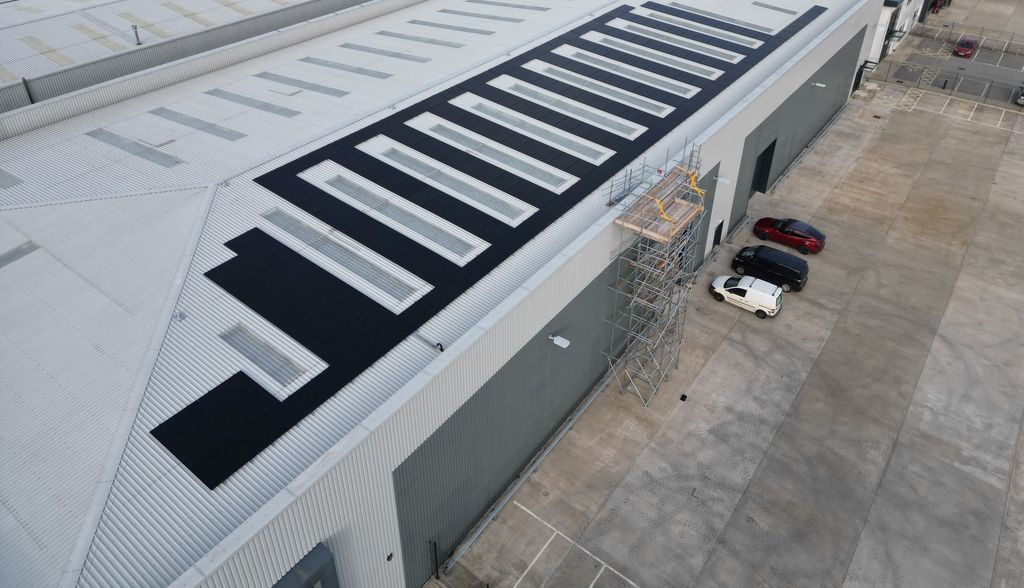
99 kWp rooftop solar on a warehouse, Oldham.


Frequently asked questions
Can my warehouse roof take solar panels?
Most modern metal roofs can, but we always check the structure and condition first. On larger systems we arrange a structural assessment.
We lease our unit. Can we still have solar?
Yes, with the landlord’s consent. We can provide the information landlords usually need, and a PPA can suit leased buildings.
What about an asbestos (fibre cement) roof?
It may still be possible, but it needs assessing. Options include over-cladding or putting the array elsewhere on site.
How long does installation take?
It depends on system size and access. A 50–150 kWp roof typically takes about 1–2 weeks on site, and G99 approval typically adds 8–12 weeks beforehand. We’ll give you a programme before work starts.
Will we lose power during installation?
Only briefly, for the final connection, and we can schedule that out of hours.
Do you install outside East Yorkshire?
Yes. We install commercial systems nationwide from our base in Beverley.
Do we need planning permission?
Many rooftop systems on commercial buildings fall under permitted development, subject to conditions and size limits. We’ll check for your site and apply if it’s needed.
Get an industrial solar assessment
Send us a recent electricity bill and we’ll come back with an initial view on system size and whether solar makes sense for your building.
Call 01482 765063 · info@brightedgesolar.com
BrightEdge Solar Ltd, Colonial House, Swinemoor Lane, Beverley HU17 0LS. MCS certified (NIC-601602). RECC member.