Short answer: A ballasted system holds solar panels on a flat roof with weight instead of fixings, so the roof membrane isn’t drilled. It suits most commercial flat roofs, as long as the structure can take the added load and the design suits the wind on your site. Modern low-ballast systems link the frames together, so the whole array acts as one stable structure and needs less weight.
Key facts
- Ballasted mounting means no holes through the waterproofing.
-
Every design is a balance between enough weight to resist wind uplift and little enough to stay within the roof’s capacity.
-
Panels on flat roofs usually sit at a low angle, often in east/west rows. This keeps wind loads down and fits more panels on the roof.
- The roof membrane’s warranty matters. Some manufacturers specify protective pads under the mounting.
How a ballasted system works
The panels sit on frames that rest on the roof surface. Concrete blocks or trays add weight where the wind calculations need it. Deflectors on the edges of the rows stop wind getting underneath. In a low-ballast system, the frames are linked together across the roof, so the array behaves like one large raft rather than hundreds of separate tables. That’s what lets it stay put with far less added weight.
Every layout is designed for its site, using the building height, the roof’s position, the local wind zone and how exposed it is. Corners and edges see the highest wind loads, so they usually carry more ballast or are left clear.
East/west or south-facing?
On flat roofs, we often lay panels in low east/west rows, back to back. Generation is spread from morning to late afternoon, which suits a working site. You also fit more panels on the roof, and the low angle keeps wind loads down. South-facing rows give a higher midday peak, but they need gaps between rows to avoid shading, so fewer panels fit.
The four things that decide whether it works
1. Roof loading
The structure has to carry the panels, frames and ballast, plus snow, on top of what it already carries. We check the roof’s capacity and, on larger roofs, arrange a structural assessment. If the roof can’t take enough ballast for the wind, options include a lighter system, some mechanically fixed points, or a smaller array.
2. Wind
Exposed, coastal and high-level roofs need more care. Linked low-ballast systems, low panel angles and careful layouts all help keep the weight down without compromising stability.
3. The membrane and its warranty
Single-ply membranes, EPDM, felt and asphalt each have their own rules. Ask your roofing contractor or the membrane manufacturer what they need to keep the warranty valid. That might be protective pads under each foot, a separation layer, or keeping clear of certain zones.
4. Access, drainage and future maintenance
Leave routes for maintenance, keep outlets and gutters clear, and plan for any future roof work. Cables run in cable tray across the roof rather than lying loose.
In practice: three flat roofs we’ve done
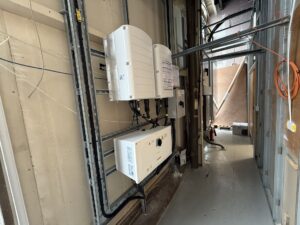
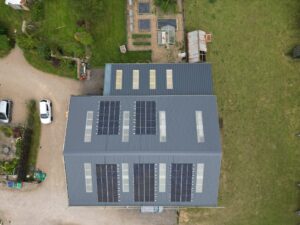
- New-build care home, Clifton, York: 47.08 kWp of 88 JA Solar 535 W panels on a Van der Valk ballasted system, on a flat membrane roof with a slight pitch. The roof had to take the array without any strengthening, so the loading had to stay under 32 kg/m². The original mounting choice was ruled out by the roof’s pitch and its weight. We used ballast wings in place of side deflectors and mass carriers to stay under the limit. Partway through, the roof warranty required a protective pad under each of the system’s 250-plus rubber feet, so we lifted the sections already in place, fitted the pads and re-ballasted them. We also fitted deflectors and ballast carriers along the visible edges so the ballast is hidden from the road. All of this happened while the building was still going up.
-
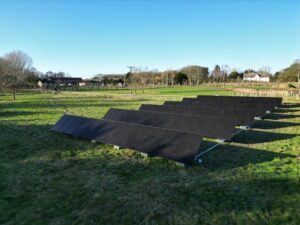
Woodsmith Mine change house, near Whitby: a 51.03 kWp east/west array on an exposed, high-wind site on the North Yorkshire coast. It uses Van der Valk low-ballast mounting laid out in three groups, with the frames linked so the array works as one structure. The low panel angle keeps wind loads down. We worked under the main contractor’s site rules, with inductions, permit-based isolation and agreed RAMS.
-
University of Kent, Canterbury: 755 kWp across seven buildings. On the flat roofs, panels sit in low east/west rows on ballasted mounting, held down by weight so the membrane isn’t drilled. On one roof, we removed an older ballasted array before fitting the new one.
Ballasted vs mechanically fixed
| Ballasted | Mechanically fixed | |
|---|---|---|
| Holes in the waterproofing | None | Yes, sealed at each fixing |
| Added roof load | Higher | Lower |
| Best for | Roofs with spare structural capacity | Lightweight roofs that can’t take ballast |
| Removal for roof works | Straightforward | Fixings need making good |
For pitched metal roofs, see our warehouse roof checklist instead.
Frequently asked questions
Do ballasted solar panels damage flat roofs? Not when they’re designed and installed properly. There are no fixings through the membrane, and protective pads or layers are used where the roof manufacturer requires them.
How much weight does a ballasted solar system add? It depends on the system, the layout and the wind on your site. On a care home in York, we kept it under 32 kg/m² so the roof didn’t need strengthening.
Can ballasted solar go on a windy or coastal roof? Yes, with the right design. Linked low-ballast systems, low panel angles and careful layouts keep the array stable without overloading the roof, as on our exposed site near Whitby.
Will it affect my roof warranty? It can if the membrane manufacturer’s requirements aren’t followed. We check what your warranty needs before we design.
Get your flat roof assessed
Send us the address, the roof type and any drawings you have. We’ll check the structure, the wind exposure and the membrane, and design a layout that suits your roof.
Book a free survey · Call 01482 765063
Related guides: Commercial solar · Commercial solar panel cost · Warehouse roof solar checks · Solar for modular buildings