CHAS Elite accredited · MCS certified · RECC member
Is solar right for your church?
Church of England guidance describes solar as generally “the icing on the cake”: the last part of a package, after lighting, heating controls and insulation have been sorted. It works best where:
There’s steady daytime use. A church with a weekday nursery, café, office, foodbank or hall bookings uses far more of its own solar than one open on Sundays only.
The roof is sound. Panels should go on a well-maintained, structurally sound roof, so any repairs come first.
The hall or vicarage is an option. Church halls and other ancillary buildings are often less sensitive than the church itself, and can sometimes take a larger array.
A battery fits the pattern. Stored midday generation can cover evening events and lighting.
If your use is very light, we’ll tell you. A smaller system on the hall, or a different measure, may be the better spend.
Faculty, DAC and listed buildings
For Church of England churches, solar needs permission under the faculty system. Since 2022, panels on a church that isn’t listed and isn’t in a conservation area can go through the simpler List B route. Listed churches and those in conservation areas need a full faculty, and planning permission may also apply. Visible panels on a listed church aren’t ruled out, but you’ll need a stronger case for the benefits.
Your DAC will usually want to see:
drawings and a description of the work
technical details: fixings, cable routes and where the inverter and any battery go
a structural statement covering the weight of the array and wind loading
how the installation can be maintained and, ideally, reversed
We supply the design, drawings, equipment and fixing details, and we’ll arrange the structural input your DAC needs. Other denominations have their own processes, which we’re happy to work through.
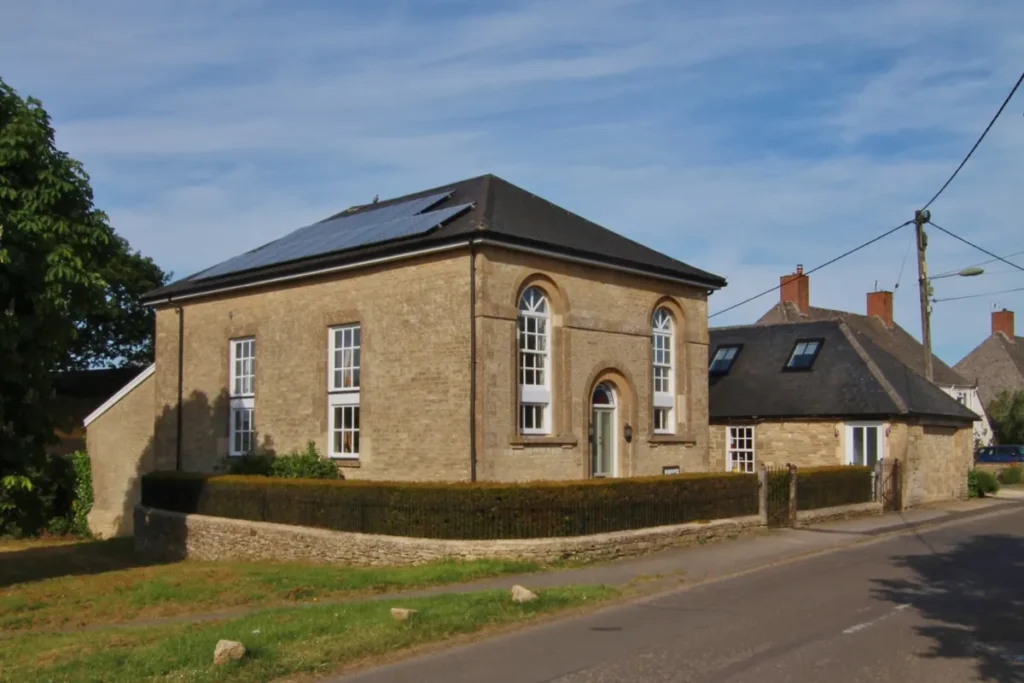
Photo: Leafield Baptist Chapel by Motacilla, Wikimedia Commons, CC BY-SA 4.0
Grants and funding for church solar
Funding changes from year to year, so treat this as a map and we’ll check what’s live when we quote.
Church of England Net Zero Carbon Programme. The Decarbonising Churches Grant Fund opened to churches in all dioceses from June 2026 and supports planning and capital works, with solar included where appropriate. Give to Go Green helps you match-fund money you raise locally. Start with a conversation with your diocese’s Net Zero Carbon Officer or Diocesan Environment Officer.
Quick Wins grants through your diocese. Smaller grants paid out by each diocese. Eligible work varies: some dioceses list solar PV, others focus on lighting, heating and insulation. In the Diocese of York, for example, applicants need a recent Energy Footprint Tool return and Eco Church registration.
Benefact Trust building grants. These can fund energy-efficiency and carbon-reduction measures, including solar PV and battery storage, where an eco-audit or other professional or denominational advice recommends them.
Local community funds. In the East Riding, the council’s wind farm community funds accept applications from faith-based groups for community projects in each fund’s area of benefit. Other areas have similar funds.
Community energy. A community energy group can sometimes fund and own panels on your roof and sell you the electricity at a lower price.
One to skip: the National Churches Trust doesn’t fund solar panels. Its grants focus on urgent repairs, project development, kitchens and toilets.
0% VAT. Solar panels and batteries installed in a building used solely for a relevant charitable purpose are zero-rated until 31 March 2027, then 5%. A church used for worship will normally qualify, and we’ll ask you for a short letter confirming how the building is used. See solar panels for charities for more on the VAT relief, and our solar panel grants hub for every sector.
Surplus power can earn Smart Export Guarantee payments from a supplier that offers an SEG tariff.
We run your grant application with you
Grant forms take time most organisations don’t have, so we take on the heavy lifting. We run the grant application with you and do the legwork: technical details, quotes, generation forecasts and paperwork. We’ll check which funds you’re eligible for, gather the evidence funders ask for and keep the application moving, alongside the drawings and specifications your DAC needs. If the grant pays in stages, we’ll work to that schedule.
Typical costs and payback
As a guide from our commercial work, a 30 kWp system typically costs about £17,000–£21,000 before VAT, and battery storage about £350–£450 per kWh installed. Scaffolding, heritage-friendly fixings and longer cable runs can add to that.
Payback depends mostly on how much of the electricity you use on site. We’ll model it from your bills, show it in plain figures for your PCC, and say so if it doesn’t stack up.
How we deliver it
Free desktop look at your roof and bills, so the PCC can decide whether to go further.
Site survey: roof condition, structure, shading, the electrical supply and where kit can go discreetly.
Proposal and drawings for your DAC, funders and PCC, with expected generation and an itemised quote.
G99 grid application to the network operator, usually Northern Powergrid in Yorkshire, where the system size needs it.
Installation planned around services, weddings, funerals and hall bookings.
MCS handover: MCS certificate, handover pack and monitoring, with ongoing servicing and maintenance available.
For Church of England churches, yes, you need permission under the faculty system. Panels on a church that isn’t listed and isn’t in a conservation area can use the simpler List B route. Your DAC secretary will confirm which applies.
It can, but each case is judged on its merits. Visible panels on a listed building need a stronger case for the benefits, and planning permission may also be needed. We can often find a less visible roof slope or use the church hall.
The Church of England’s Decarbonising Churches Grant Fund, Give to Go Green and diocesan Quick Wins grants, Benefact Trust building grants and some local community funds. Rounds change, so we’ll check what’s open when we quote.
Yes, as part of a heating project. The Church of England expects most funded projects to be new zero-carbon electric heating, “potentially complemented by solar PV and batteries”. Where solar is included to make the new heating affordable to run, the panels, battery and installation can be funded. Stand-alone solar is better funded through other grant streams or locally. See our Decarbonising Churches Grant Fund guide.
It can. The Decarbonising Churches Grant Fund covers churches and church halls in buildings owned by part of the Church of England, on the same terms: solar alongside low-carbon heating. For smaller projects, ask your diocese’s Net Zero Carbon Officer about the Quick Wins fund, which offers grants of up to £10k, generally £3–5k. Halls that are separately run charities may also be able to use the trust and community funds listed above.
Yes. Chapels, meeting houses and other places of worship follow their own denomination’s approval process rather than the Church of England faculty system, and we’re happy to work through it with you. A building used by a charity other than in the course of a business normally qualifies for 0% VAT on solar panels and batteries until 31 March 2027.
Solar panels and batteries in a building used solely for a relevant charitable purpose are zero-rated until 31 March 2027, then 5%. A church used for worship will normally qualify. We’ll ask you for a short letter confirming how the building is used.
Yes. We supply drawings, equipment and fixing details, cable routes and the expected generation, and we’ll arrange the structural input. Most DACs are glad to see a well-prepared application.
Yes, and we do most of the work. We run the grant application with you and do the legwork: technical details, quotes, generation forecasts and paperwork. You review it and sign it off as the applicant.
Yes. Our survey is free and there’s no obligation, so the PCC can decide with real figures in front of them.
Book a free church solar survey
Send us a recent electricity bill and a few photos of the roof. We’ll come back with an honest first view, before anyone commits to anything.
Book a free survey · Call 01482 765063 · info@brightedgesolar.com
BrightEdge Solar Ltd, Colonial House, Swinemoor Lane, Beverley HU17 0LS. MCS certified (NIC-601602). RECC member.