Last updated 12 November 2026 · BrightEdge Solar team
Short answer: In England, most solar panels on the roof of a business, farm, school or other non-domestic building don’t need a full planning application. They’re permitted development under Class J of the General Permitted Development Order, and there’s no longer a 1 MW size cap.[1][2] Systems up to 50 kW go ahead without an application if they meet the size and position limits. Above 50 kW, you must first ask the council whether it needs to approve the design and appearance (prior approval), which takes up to 56 days.[1][3] Listed buildings, scheduled monuments and most ground-mounted arrays still need permission.
Planning is one of the first questions we’re asked on a commercial job, usually alongside the grid connection. The rules changed in December 2023, when the government removed the 1 MW limit on rooftop solar for non-domestic buildings.[2] A lot of older guidance, and some quotes, still describe the old rules. This guide sets out what the law says today for commercial solar planning permission in England, where the limits are, and what to check before you sign anything. It covers England only. Scotland, Wales and Northern Ireland have their own rules.
Key facts
- No size cap on commercial rooftop solar. Since 21 December 2023, Class J has no 1 MW threshold for solar PV on non-domestic roofs.[2]
- 50 kW is the line that matters. “Microgeneration” means up to 50 kW of electrical capacity.[3] Roof or wall systems up to that size are permitted development without an application, if they meet the limits. Larger roof systems need a prior approval application first.[1]
- Position limits apply to every system. Panels can’t sit within 1 metre of the roof edge, can’t stick out more than 0.2 metres from a pitched roof, and can’t stand more than 1 metre above the highest part of a flat roof.[1]
- Listed buildings are excluded. Class J doesn’t cover a listed building, a building in the curtilage of one, or a scheduled monument.[1]
- Car park canopies have their own route. Solar canopies over non-domestic off-street parking are permitted up to 4 metres high, subject to prior approval.[1][2]
What permitted development means for a business roof
Permitted development rights are a planning permission granted nationally by the General Permitted Development Order 2015, so you don’t need to make a planning application, as long as the work stays inside the limits and meets the conditions.[1][5] For solar on non-domestic buildings, the relevant rule is Part 14, Class J. It covers:
- solar PV or solar thermal microgeneration (up to 50 kW) on a building, on the roof or a wall, and
- other solar PV (above 50 kW) on the roof of a building other than a house or block of flats.[1][3]
That takes in warehouses, factories, offices, shops, farm buildings, schools, care homes, churches and community buildings. The panels must be sited, as far as practicable, to minimise their effect on the building’s appearance and the surrounding area, and removed when no longer needed.[1]
The limits every system must meet
| Rule | What Class J says |
|---|---|
| Pitched roof | Panels can’t protrude more than 0.2 m beyond the roof slope |
| Flat roof | The highest part of the panels can’t be more than 1 m above the highest part of the roof (chimneys excluded) |
| Roof edge | No panels within 1 m of the external edge of the roof |
| Listed buildings | Not permitted on a listed building or a building within its curtilage |
| Scheduled monuments | Not permitted on a scheduled monument site |
| Walls (up to 50 kW only) | No more than 0.2 m proud of the wall, not within 1 m of a junction with another wall or the roof, and not on a wall fronting a highway in a conservation area, National Landscape, National Park, the Broads or a World Heritage Site |
Source: GPDO 2015, Schedule 2, Part 14, Class J (version in force from 21 October 2026).[1][4]
The 1-metre rules shape flat-roof designs. On ballasted east-west systems, we keep the rows back from the roof edge and keep the frames low, which also helps with wind loading. See ballasted flat-roof solar.
Above 50 kW: how prior approval works
For rooftop systems above 50 kW, permitted development still applies, but only after a short application to the local planning authority. The council decides whether it needs to approve the design or external appearance, “in particular the impact of glare on occupiers of neighbouring land”.[1] It isn’t a full planning application.
What you send
- a written description of the proposed development
- a plan showing the site and the proposed development
- your contact address (and email, if you’re happy to be contacted that way)
- the fee.[1]
What the council does
The council puts up a site notice for at least 21 days or writes to neighbouring owners and occupiers. It takes any comments into account and has regard to the National Planning Policy Framework. It can ask for more information, and it can refuse if the proposal doesn’t meet the Class J limits or there isn’t enough information to tell.[1]
When you can start
Work can’t start until one of these happens:
- the council tells you in writing that prior approval isn’t needed
- the council gives prior approval (possibly with conditions)
- 56 days pass from the date the council received the application without it telling you its decision.[1]
The system must then be built to the approved details, or to the details in your application.[1] In practice, the prior approval clock can run alongside the G99 grid application, which for larger systems is usually the longer of the two. See how long G99 takes.
When you’ll still need planning permission
Listed buildings and scheduled monuments
Class J doesn’t apply, so you’ll need a planning application. Works that would affect a listed building’s character also need listed building consent.[1][6] Many churches have their own consent process alongside planning. See our guide to church solar and faculty permission.
Ground-mounted arrays
Stand-alone solar on non-domestic land is permitted development under Class K only on a small scale: one installation, no more than 9 m² of panels, no dimension over 3 m, no higher than 4 m and at least 5 m from the boundary.[1] Most farm and business ground mounts are much bigger than that, so they normally need a planning application. See farm solar panels.
Where your rights have been removed
A council can remove permitted development rights with an Article 4 direction, or by a condition on an earlier planning permission for your building.[5] It’s worth checking your building’s planning history.
When you’re not sure
If it isn’t clear whether your project is permitted development, you can apply to the council for a lawful development certificate, which gives a legally binding decision.[5]
Protected areas: conservation areas, National Landscapes and National Parks
These are “article 2(3) land” in the planning rules.[4] Since the 2023 changes, rooftop solar on a non-domestic building in these areas is treated the same as elsewhere, including on a roof slope that faces a road.[2] The extra restriction is on walls: wall-mounted panels can’t go on a wall fronting a highway.[1] Stand-alone panels nearer the road than the building are limited to 2 m high and need prior approval for their appearance.[1]
Solar canopies over car parks
Class OA allows solar canopies over areas lawfully used as off-street parking, other than parking for a house or block of flats. No part can be more than 4 m above ground level or within 10 m of the curtilage of a house or block of flats, and it can’t be within the curtilage of a listed building or on a scheduled monument. Every canopy needs prior approval for its siting, design and appearance, including glare, and must be completed within 3 years.[1]
Planning is only one of the approvals
Even when no planning application is needed, a commercial system usually needs:
- grid approval from the network operator. Larger systems need a G99 application. See G98 or G99? and our G99 applications page.
- landlord consent if you lease the building
- a structural check that the roof can carry the panels
- a word with your building insurer.
Our warehouse roof checklist covers these in more detail.
In practice: large flat roofs
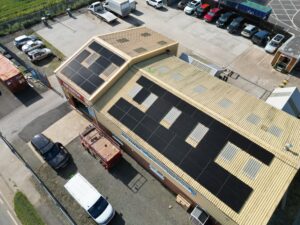
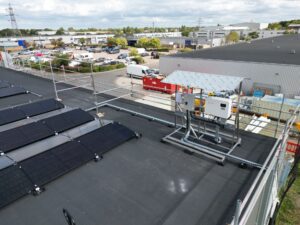
At an occupied industrial estate in Peterborough, we installed 300.06 kWp of east-west solar on the flat roofs of three units, with three grid connections, while the units stayed in use. See the Peterborough industrial estate case study. For the University of Kent, we installed 755 kWp across flat campus roofs. Under today’s Class J rules, rooftop systems of this size would go through the prior approval route rather than a full planning application, provided the building isn’t listed and the limits are met.
Frequently asked questions
Do I need planning permission for solar panels on my business roof?
Usually not, in England. Rooftop solar on a non-domestic building is normally permitted development under Class J. Systems above 50 kW need a prior approval application to the council first. Listed buildings and scheduled monuments are excluded and need permission.
Is there still a 1 MW limit for commercial rooftop solar?
No. The 1 MW threshold was removed on 21 December 2023. There’s now no capacity cap on rooftop solar on non-domestic buildings under Class J, but systems above 50 kW need prior approval.
How long does prior approval for commercial solar take?
The council has 56 days from receiving the application. If it hasn’t told you its decision by then, you can go ahead in line with your application. It may decide sooner that prior approval isn’t needed.
Do ground-mounted solar panels need planning permission?
Usually, yes, for a business or farm. Permitted development only covers one small stand-alone array: up to 9 square metres of panels, no dimension over 3 metres, no higher than 4 metres and at least 5 metres from the boundary.
Can we put solar panels on a building in a conservation area?
Usually, yes, on the roof. Since December 2023, rooftop solar on non-domestic buildings in conservation areas is treated like anywhere else, including on roof slopes facing a road. Wall-mounted panels can’t go on a wall fronting a highway, and listed buildings need permission.
Do you deal with planning as part of the project?
Yes. We check the planning route during the survey and design, and we handle planning where it’s needed, alongside the G99 application and other approvals.
Ready to check your site?
We’ll check the planning and grid route as part of your survey, then design a system around your demand and set out the cost, expected generation and estimated payback in plain figures. We install commercial solar and batteries across Hull, East Yorkshire, Yorkshire and the North of England, with a 24-month workmanship warranty on commercial installs. We’re MCS certified and CHAS Elite accredited.
Book a free survey · Call 01482 765063
Sources
- The Town and Country Planning (General Permitted Development) (England) Order 2015, Schedule 2, Part 14 (Classes J, K and OA, and paragraph J.4), latest version in force from 21 October 2026: https://www.legislation.gov.uk/uksi/2015/596/schedule/2/part/14 (checked 12 Nov 2026)
- The Town and Country Planning (General Permitted Development etc.) (England) (Amendment) (No. 2) Order 2023, SI 2023/1279, Explanatory Note (articles 6 to 8), in force 21 December 2023: https://www.legislation.gov.uk/uksi/2023/1279/note/made (checked 12 Nov 2026)
- Energy Act 2004, section 82 (definition of microgeneration: 50 kilowatts electrical): https://www.legislation.gov.uk/ukpga/2004/20/section/82 (checked 12 Nov 2026)
- The Town and Country Planning (General Permitted Development) (England) Order 2015, article 2 (article 2(3) land): https://www.legislation.gov.uk/uksi/2015/596/article/2 (checked 12 Nov 2026)
- GOV.UK, Planning practice guidance: When is permission required? (paragraphs 020 and 024): https://www.gov.uk/guidance/when-is-permission-required (checked 12 Nov 2026)
- Planning (Listed Buildings and Conservation Areas) Act 1990, section 7: https://www.legislation.gov.uk/ukpga/1990/9/section/7 (checked 12 Nov 2026)