Last updated 3 November 2026 · BrightEdge Solar team
Short answer: Solar export limitation lets you fit more solar, or a battery, than the local network can take back. A G100 export limitation scheme measures the current at your supply point and turns the inverters down so that export never goes above the limit agreed with your network operator.[1] You still use everything you generate on site. Only the surplus above the cap is lost, unless a battery or extra daytime use soaks it up.
When you apply to connect solar, the Distribution Network Operator (DNO) checks what the local network can handle. In Hull and East Yorkshire that’s Northern Powergrid. Sometimes the answer is “yes, but only if export is capped”. Customers can choose to restrict the power they send to the network instead of waiting for, or paying towards, reinforcement.[1] This guide explains how a G100 scheme works, how much bigger it can make your system, and what it costs in lost generation. For the full application process, see our G99 application guide.
Key facts
- G100 is the national standard. It’s the Energy Networks Association’s technical standard for customer export and import limitation schemes. The current version is Issue 2 Amendment 2, published in April 2023.[1]
- The limit is agreed with the DNO. It’s called the Maximum Export Limit (MEL) and it’s written into your Connection Agreement.[1]
- The scheme has to react quickly. If export goes over the limit, it must be back under within one minute by default. If the scheme fails, or loses communication, it must make the system safe within 15 seconds.[1]
- The settings are locked. They must be protected by a password, PIN or seal so the customer can’t change them.[1] National Grid Electricity Distribution says settings can only be changed with the DNO’s written agreement.[5]
- MCS requires it. MCS installers must follow G100 wherever the export of power is to be limited.[6]
What solar export limitation actually does
A G100 scheme, which the standard calls a Customer Limitation Scheme (CLS), has three parts:[1][5]
- A measuring device at the point where your site connects to the network, usually near the meter. It reads the current flowing in or out.
- A controller that compares that reading with the agreed limit.
- The inverters, and any battery, which the controller turns down whenever export would go over the limit.
When your building uses more power than the panels make, nothing changes. The scheme only steps in when generation is high and demand is low, such as a sunny weekend at a warehouse. Then it trims inverter output so export stays at, or under, the limit.
A zero-export connection is the same idea with the limit set to nothing. For non-exporting sites, G100 also allows reverse power protection as an alternative to a full limitation scheme.[1]
Export limiting isn’t the same as fitting a smaller inverter, or setting the inverter’s maximum output in software. That changes the size of the generator that the DNO assesses. A G100 scheme leaves the generator at full size and caps the net flow at the meter.[5]
How much bigger can the system be?
Bigger, but not unlimited. Even with a scheme in place, the DNO works out the largest generation capacity it will accept. It checks the cables and fuses (thermal), the protection, and the voltage rise during brief over-limit moments.[1] National Grid Electricity Distribution puts it plainly: “G100 installed capacity is not unlimited”.[5]
The worked examples in G100 show how this works out:[1]
- A home with an 80 A main fuse and a 16 A export limit. The DNO’s voltage check sets the ceiling. Up to 44 A of PV inverters (10 kW) can be installed, with export capped at 16 A.
- A farm wanting a 200 kW wind turbine. The DNO can only offer an export limit of 220 A (152 kW) because of voltage rise. With a scheme limiting export to 152 kW, the full 200 kW turbine is acceptable.
These are the ENA’s illustrations. Every DNO assessment is site-specific.
Common export limits in kW
Limits are set in amps per phase, although DNO offers often give the kW figure as well.[1] A fully type-tested scheme for a domestic-sized connection must offer these settings:[1]
| Export limit (per phase) | Single-phase (approx.) | Three-phase (approx.) |
|---|---|---|
| 16 A | 3.68 kW | 11.04 kW |
| 32 A | 7.36 kW | 22.08 kW |
| 60 A | 13.8 kW | 41.4 kW |
| 80 A | 18.4 kW | 55.2 kW |
| 100 A | 23 kW | 69 kW |
Figures at the nominal 230 V and unity power factor, the same basis G100 uses in its examples. Larger commercial connections are given a site-specific limit in the Connection Agreement.
Where G100 fits in your grid application
Export limitation doesn’t replace the G99 application. It’s part of it.
- G99 still applies. A G99 installation that includes a G100 scheme must comply with G100 as well.[3] Northern Powergrid publishes G100/2 Form A (application information for limitation schemes) and Form C (the installation document) with its connection forms.[4]
- It can unlock simpler routes for small systems. Under G99’s Small Generation Installation procedures, systems of up to 32 A or 60 A per phase can use a faster route if a fully type-tested G100 scheme caps export at 16 A or 32 A per phase.[2][3] Our G98 vs G99 guide explains the thresholds.
- Commissioning has its own paperwork. A G100 commissioning form is always completed.[1] Fully type-tested schemes need fewer site tests, but the communication-failure and power-failure tests are still done.[1]
- It stays on the record. The installer must give you a schematic of the scheme, and an operating diagram must be displayed on site. The DNO can ask for the tests to be repeated, including after a fault or a change of equipment.[1]
If you later add panels, change inverters or fit a battery, the DNO may need to approve the change first. For how long the whole process takes, see our G99 application timeline.
The trade-off: curtailed generation
On some days, the panels could make more than you can use or export. That surplus is curtailed: the inverters simply produce less. How much you lose depends on how your demand lines up with generation:
- Sites that use most of their power in daylight hours, such as factories, cold stores and busy farms, rarely hit the cap, so the limit costs very little.
- Sites that are quiet at weekends or in summer hit it more often.
Three common ways to reduce the loss:
| Option | How it helps | Watch out for |
|---|---|---|
| Battery storage | Stores generation that would otherwise be curtailed, for use later | A battery counts as generation in the G99 application |
| Shift daytime loads | Run chillers, pumps, chargers or heating when the sun is out | Depends on how the business works |
| Size to the limit | A smaller system that rarely curtails | May leave roof space and savings unused |
Exported power still earns money. Suppliers that offer the Smart Export Guarantee (SEG licensees) must offer a tariff to all eligible generators, and the rate must always stay above zero.[7] But exported power usually earns much less than the price you pay for imported power. So for many businesses, using more on site matters more than exporting more. Our guide to whether a business battery pays for itself covers this in more detail.
In practice: export control on East Yorkshire and Doncaster jobs
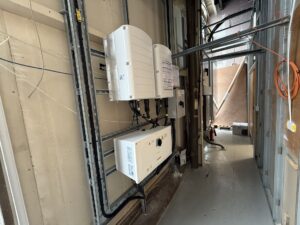
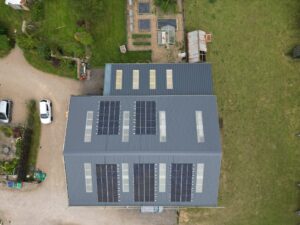
At Wapplington, near Pocklington, we installed a 29 kWp ground-mounted array with 30 kW of total inverter power and a purpose-built plant room. A Solis Export Power Manager gives real-time power data and adjustable export-limit control.
On an 86 kWp rooftop system in Doncaster, we sized the new SolarEdge inverter to fit the site’s existing G99 approval. A SolarEdge ONE Commercial Controller handles G99/G100 export limitation.
When this doesn’t apply
- Your system is smaller than the limit. G100 doesn’t apply where the total generation rating is below the agreed export limit.[1]
- The DNO offers full export. If the network can take everything, you don’t need a limit.
- Very low daytime demand and no battery. If most of the output would be curtailed, size for your actual use instead.
- Larger and high-voltage sites. These need extra protection, such as a reverse power relay at high voltage, and are assessed case by case.[1][5] Small, single-phase sites have tighter limits too. National Grid Electricity Distribution, for example, caps single-phase installed generation at 17 kW for G99 compliance.[5]
Frequently asked questions
Can I fit more solar panels than my export limit allows?
Usually, yes. That’s the point of a G100 export limitation scheme. You can install more generation than the agreed export limit, as long as the DNO accepts the total capacity after checking thermal limits, protection and voltage rise. The scheme then caps the power leaving your site at the agreed limit.
Do I lose the solar power I generate with an export limit?
Not the power you use. Generation is used on site first, and only the surplus above the export limit is curtailed. A battery or moving daytime loads can capture much of that.
What is a zero-export solar system?
It’s a connection where the export limit is set to nothing, so all generation is used on site or stored. G100 covers these schemes, and also allows reverse power protection as an alternative for sites that don’t export.
Do I still need a G99 application if I have an export limiter?
In most cases, yes. Export limitation is part of the grid application, not a way around it, although for small systems a fully type-tested G100 scheme can allow a simpler G99 route.
Can I change my export limit later?
Not yourself. The limit is written into your Connection Agreement and the settings are locked. You would need to apply to your DNO, and changes to the scheme may need retesting.
Who sets the export limit in Hull and East Yorkshire?
Northern Powergrid, the network operator for Hull, East Yorkshire and much of the North East. It assesses the G99 application and sets any export limit in the connection offer, and it publishes the G100 Form A and Form C used for limitation schemes.
Has the DNO limited your export?
Send us your address, a recent electricity bill and any DNO offer letter or existing G99 approval. We’ll look at whether an export limit, a battery or a different system size suits you best. Every commercial project starts with a free site survey, and we handle the grid connection paperwork as part of the project.
Book a free survey · Call 01482 765063
Sources
- Energy Networks Association, Engineering Recommendation G100 Issue 2 Amendment 2 (2023), Technical Requirements for Customer Export and Import Limitation Schemes: https://www.energynetworks.org/assets/images/ENA_EREC_G100_Issue_2_Amendment_2_(2023).pdf (checked 3 Nov 2026)
- Energy Networks Association, Connecting commercial generation to the electricity networks: https://www.energynetworks.org/industry/connecting-to-the-networks/connecting-generation-to-the-electricity-networks (checked 3 Nov 2026)
- Energy Networks Association, Engineering Recommendation G99 Issue 2 (2025), sections 6.2.2 and 10.1.7, published by the Distribution Code: https://dcode.org.uk/assets/250307ena-erec-g99-issue-2-(2025).pdf (checked 3 Nov 2026)
- Northern Powergrid, Connections application forms (Export Limitation Schemes: G100/2 Form A and Form C): https://www.northernpowergrid.com/connections-and-services/connections-application-forms (checked 3 Nov 2026)
- National Grid Electricity Distribution, Customer Export Limitation Schemes: https://connections.nationalgrid.co.uk/customer-export-limitation-schemes (checked 3 Nov 2026)
- MCS, MIS 3002 Solar PV Systems Installation Standard, Issue 6.0, clause 5.1.8: https://mcscertified.com/wp-content/uploads/2026/03/MIS-3002_Solar-PV-Systems-V6.0-Final.pdf (checked 3 Nov 2026)
- Ofgem, Smart Export Guarantee (SEG): generators: https://www.ofgem.gov.uk/environmental-and-social-schemes/smart-export-guarantee-seg/generators (checked 3 Nov 2026)