Short answer: Battery storage is worth it when your site makes more solar power than it uses during the day, and buys power back at a high price later. It also helps when the grid limits how much you can export, or when you need backup. If your site uses nearly all its solar as it’s generated, a battery usually adds cost without much return. The only way to know is to model it against your own half-hourly data.
Key facts
- Commercial batteries typically cost about £350–£450 per kWh installed, including a hybrid inverter, excluding VAT.
-
A real retrofit example: 42 kWh with a 20 kW hybrid inverter came to about £16,000.
-
Export payments can be low. One of our farm customers was offered 4p/kWh, which is why they chose to store their surplus instead.
- An oversized battery that never fully cycles is money sitting idle.
Four situations where a battery pays
1. You export a lot of solar cheaply
If your site is quiet at weekends or in the evening, a lot of your summer generation goes to the grid. When export pays only a few pence per kWh and you buy power back later at your normal rate, storing that surplus is worth far more than selling it. That’s the case for most farm and small-business batteries we fit.
2. Your power costs more at certain times
Many business tariffs, and the network charges built into them, cost more at peak times. In Northern Powergrid’s Yorkshire area, the “red” period runs from late afternoon into the evening on weekdays. A battery charged from solar, or from cheap overnight power, can cover that window. Check your own bill or ask your supplier how your tariff is structured, because it varies.
3. The grid limits your export
Larger systems need G99 approval, and the network operator may only allow a limited export, or ask for expensive upgrades. A battery lets you size the solar for your building, store what you can’t export, and keep within the agreed limit with an export limitation scheme. Sometimes that’s the difference between a project working and not. See G99 applications.
4. You can’t afford to lose power
With the right equipment, a battery can keep chosen circuits, or a whole building, running during a power cut. This has to be designed in from the start, not added later.
When a battery doesn’t pay
- Your site uses nearly all its solar as it’s generated. This is common on busy weekday operations such as factories, workshops and care homes. A sports clubhouse we fitted chose no battery for the same reason. See Hessle Sporting Club.
-
The battery is sized too big. If it rarely fills or empties, you’ve paid for capacity you don’t use.
-
There’s nowhere sensible to put it. Batteries need a suitable, ventilated spot away from escape routes and heat, and your insurer should know about it.
How to size one properly
Don’t guess. Ask your supplier for your half-hourly consumption data, since most commercial meters record it. We combine it with your measured or modelled solar generation, your tariff and any export limit. Then we model how much of your solar you’d use with and without storage. The right battery is the one that cycles most days and covers your expensive hours, not the biggest one you can afford.
In practice: three batteries we’ve installed
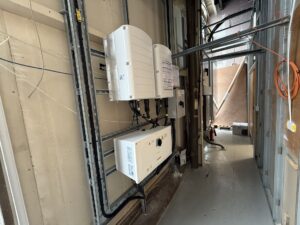
- Barn battery retrofit, East Riding: with export paid at just 4p/kWh, the client wanted to store their surplus instead. We replaced their Solis 20 kW inverter with a Fox ESS H3 20 kW hybrid, reused the existing cabling, and fitted 41.93 kWh of Fox ESS batteries indoors in the farm shed, with new three-phase metering.
-
Farm-based business, East Riding: they wanted storage and backup. We fitted a 54.24 kWh Sigenergy battery with a backup gateway giving 60 kW of whole-building backup, and added panels to the existing array, bringing the total to about 69 kWp. The client has since come back for more panels and batteries.
-
Public-sector training centre: a 24.84 kWp roof array with a Fox ESS H3 Pro 15 kW hybrid inverter and an 11.52 kWh battery, so surplus daytime generation is used later on site.
More examples are on our battery storage page.
Adding a battery to solar you already have
Many existing systems can take a battery, either AC-coupled with a separate battery inverter, or by replacing an ageing inverter with a hybrid. We check your inverter, wiring, metering and G99 position first, because adding storage can mean telling the network operator or making a new application. We also work on systems that other firms installed.
Paying for it
A battery bought outright may qualify for capital allowances, so ask your accountant. In England, eligible batteries installed with rooftop solar are also covered by the business rates exemption until 31 March 2035. See business rates and solar panels and what commercial solar costs.
Frequently asked questions
How much does a commercial battery cost? Typically about £350–£450 per kWh installed, including the hybrid inverter, excluding VAT. A 42 kWh battery with a 20 kW hybrid inverter came to about £16,000 on a recent retrofit.
What size battery does my business need? It depends on how much solar you export and when you use power. We size it from your half-hourly data, so the battery cycles most days rather than sitting half-empty.
Can a battery work without solar? Yes. On a time-of-use tariff, it can charge when power is cheap and discharge when it’s expensive. Whether that pays depends on your tariff, so we check your data first.
Will a battery keep my business running in a power cut? Only if it’s designed for backup. With the right gateway and wiring, chosen circuits or a whole building can keep running. One of our farm installs has 60 kW of whole-building backup.
Find out if a battery pays on your site
Send us a recent bill and, if you can, your half-hourly data. We’ll model your site with and without storage, and tell you plainly if it isn’t worth it.
Book a free survey · Call 01482 765063
Related guides: Commercial battery storage · Commercial solar panel cost · Solar PPA or buy outright?