Last updated 20 October 2026 · BrightEdge Solar team
Short answer: Solar panels and batteries installed in a building used solely for a relevant charitable purpose are zero-rated for VAT until 31 March 2027, then charged at 5% from 1 April 2027.[1][2] The building must be used by a charity for non-business purposes, or as a village hall or similar. VAT follows the tax point, so aim to finish, be invoiced and pay before 1 April 2027.[10]
VAT on charity solar is currently 0%, but only until a fixed date: the zero rate that has applied to qualifying charity buildings since 1 February 2024 ends on 31 March 2027. This guide covers exactly which buildings and equipment qualify, what paperwork HMRC expects, what happens to a contract that runs past 31 March 2027, and a realistic timeline for getting installed in time. For the wider picture, including grants, see our main guide to solar panels for charities.
Key facts
- The dates: charity buildings were added to the energy-saving materials relief from 1 February 2024. The zero rate runs to 31 March 2027, then 5% applies from 1 April 2027.[1][3][4]
- The test: the building must be intended for use solely for a relevant charitable purpose. That means use by a charity other than in the course of a business, or as a village hall or similar social or recreational facility for a local community.[2]
- What’s covered: solar PV panels with cabling, control panel and inverter, plus electrical storage batteries and smart diverters.[1]
- Paperwork: there’s no certificate requirement. The installer should take reasonable steps to check how the building will be used, for example a letter from you confirming its intended use.[1]
- Could it change? The Budget is on 28 October 2026.[15] Nothing has been announced about the relief, so plan on 31 March 2027 until the law changes.
What qualifies for 0% VAT on charity solar
The building
The relief is in Group 23 of Schedule 8 to the VAT Act 1994, extended to charity buildings by SI 2024/24.[2][3] There are two ways a building can qualify:
- Non-business use by a charity. HMRC gives places of worship, charity offices that administer non-business activity, schools that charge no fees and grant-funded research buildings as examples.[9]
- A village hall or similar. HMRC’s guidance mentions sports pavilions, church halls, community centres and community sports centres. The building should be run on a non-commercial basis for the local community, with modest charges and any profit put back into the facility.[9]
Two points catch people out:
- It must be your charity using the building. A charity that simply makes a building available to another organisation free of charge isn’t using it for a relevant charitable purpose.[5]
- The customer must be a charity. HMRC says community amateur sports clubs (CASCs) don’t hold charitable status and don’t get the same VAT reliefs as charities.[9][12]
“Solely” and part-business buildings
For village halls, HMRC’s construction guidance treats a building as used solely for social or recreational activities where at least 95% of it is used that way.[9] HMRC’s energy-saving materials manual doesn’t give a separate percentage. It does say the law doesn’t allow the installation to be apportioned. The VAT rate depends on whether the panels mainly serve a qualifying building.[8] If part of your building is a café, shop or space let commercially, take advice before you sign.
The equipment
| Usually qualifies (installed in a qualifying building) | Doesn’t qualify or needs checking |
|---|---|
| PV panels with cabling, control panel and AC/DC inverter[1] | Panels or batteries bought supply-only: standard-rated[1] |
| A battery fitted with new solar, normally part of one zero-rated supply[6] | Thermal or heat batteries[6] |
| A battery retrofitted to existing solar, or a standalone battery charged from the grid[6] | Servicing or repair visits: the relief is for installing materials[2] |
| Smart diverters[1] | Ground-mounted panels and their groundworks: see below |
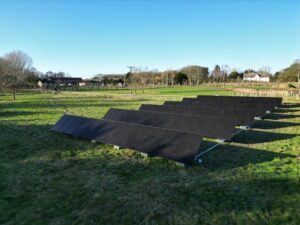
Ground-mounted arrays: HMRC says solar panels include systems installed “in, or on the site of, a building”. Its manual confirms ground-mounted panels within the curtilage of residential accommodation.[1][7] It doesn’t give a charity example. Groundworks are only named for ground and water source heat pumps.[2] If you’re planning a ground mount, get the VAT treatment confirmed early.
Installation must be by the supplier: the zero rate applies to installation services, and to materials supplied by the person who installs them.[1] If you buy panels yourself and pay someone just to fit them, the panels carry 20% VAT.
The paperwork: no certificate, but evidence
HMRC’s guidance for installers is clear. There’s no requirement for the customer to give a certificate, unlike some other zero-rated building work. The installer should take reasonable steps to check the building will be used for a relevant charitable purpose and keep the evidence, such as a letter confirming its intended use.[1][5]
You’ll also need to show you’re a charity. HMRC’s construction guidance says a Charity Commission registration number or HMRC’s recognition letter will do.[9] We’ll ask for a short letter confirming how the building is used, and we keep it on file.
Contracts that run past 1 April 2027
VAT is due at the rate in force at the tax point, so a job that straddles the deadline can end up with two rates.[10] HMRC’s normal rules:
- Single-payment jobs: the basic tax point for services is when the work is complete. A payment received or VAT invoice issued earlier creates a tax point for that amount.[10]
- Stage payments: for building work paid in stages, each tax point is the earlier of receiving the payment or issuing the VAT invoice. There’s no tax point at completion.[9]
- An early 0% invoice won’t lock in the rate. HMRC says an invoice for a zero-rated supply doesn’t create a tax point when the rate changes.[10]
- The last change worked this way. When the zero rate began on 1 April 2022, HMRC said a deposit paid before that date was taxed at the old rate, and a final payment made on or after it was zero-rated.[11]
In practice, aim to have the system installed, invoiced and paid by 31 March 2027. If a job may run late, ask for the VAT on each stage payment to be set out in the contract, and check it with your accountant. On our guide figure of about £17,000–£21,000 before VAT for a 30 kWp system, 5% VAT would add about £850–£1,050. VAT at 20% would add £3,400–£4,200.
How to plan an installation before 31 March 2027
Most charity projects need a survey, often a grant, a grid application and, for churches, permission through the church’s own system. Some of these can run side by side.
| Step | What happens | Time to allow |
|---|---|---|
| 1. Free survey and proposal | Roof, structure, shading and supply check, then expected generation and an itemised quote | Book now: everything else depends on it |
| 2. Grant (if needed) | We run the grant application with you and do the legwork | Set by the funder’s round dates and decision times, so check them first |
| 3. G99 grid application | Needed for most systems above small type-tested G98 limits (16 A per phase)[13] | The DNO standard is up to 45 working days for a low-voltage quote and 65 at high voltage, from a complete application[14] |
| 4. Church permission | Church of England churches need faculty permission. Unlisted churches outside conservation areas can usually use the simpler List B route[16][17] | Ask your DAC secretary about meeting dates early |
| 5. Install and commission | Fitting, testing, then the G99 commissioning paperwork | Days to weeks, depending on size |
| 6. Final invoice and payment | Keep within the zero rate | By 31 March 2027 |
Working back from 31 March 2027, 45 working days takes you to late January 2027, and that leaves no time to install. For a G99 system, we’d aim to have a complete application in by early December 2026. See how long G99 takes and our G99 application page.
In practice: at Hessle Sporting Club we fitted a 21.6 kWp system of 48 × Aiko 450 W panels with a Solis 20 kW three-phase inverter. It was funded by the FA with payments released in stages, commissioned in April 2025, and is estimated to generate 15,432 kWh a year. It shows a common pattern for community projects: funder approval first, then staged payments. With the VAT deadline, each stage’s payment date now matters too.
When this doesn’t apply
- Business use: charity shops, cafés, spaces let commercially and buildings used by a trading company don’t normally qualify. For business premises, read about capital allowances and business rates on solar panels.
- Schools: fee-charging schools are treated as business use, and the user must be a charity.[9] See solar panels for schools.
- CASCs and other non-charities, even if they serve the community.[12]
- Later work: routine servicing and repairs. We service systems nationwide, priced on application: see solar panel servicing.
FAQ
Do charities pay VAT on solar panels?
Not until 31 March 2027, if the panels are installed in a building used solely for a relevant charitable purpose. From 1 April 2027 the rate is 5%. Buildings used for business don’t qualify.[1][2]
Does a church or village hall qualify?
Usually. HMRC treats places of worship as non-business use. Village halls, church halls and community centres run for the local community on a non-commercial basis also count.[9]
Is battery storage included in the 0% VAT?
Yes. Electrical batteries fitted with new solar, retrofitted to existing panels, or charged from the grid all qualify in a qualifying building. Thermal batteries don’t.[6]
Do we need to give our installer a VAT certificate?
No certificate is required for this relief. Your installer should check how the building will be used and keep evidence, such as a letter from you confirming its intended use.[1]
What if our installation isn’t finished by 31 March 2027?
VAT follows the tax point of each payment. Stage payments received before 1 April 2027 can be zero-rated, while later payments are likely to be charged at 5%.[9][10][11]
Get installed before the deadline
We’ll survey the building, set out the expected generation and costs (with battery storage if it makes sense), and run any grant application with you. For a church, we’ll supply the drawings and details your DAC needs. Send us 12 months of electricity bills and a short note of how the building is used and by whom, and we’ll talk you through a timeline that works back from 31 March 2027.
Book a free survey · Call 01482 765063
This guide explains HMRC’s published rules in general terms and isn’t tax advice. For your own building, check with your accountant or HMRC.
Sources
- HMRC, Energy-saving materials and heating equipment (VAT Notice 708/6), sections 1.1, 2.1, 2.3, 2.7, 2.11, 2.19 and 2.22: https://www.gov.uk/guidance/vat-on-energy-saving-materials-and-heating-equipment-notice-7086 (checked 20 Oct 2026)
- Value Added Tax Act 1994, Schedule 8, Part 2, Group 23 (as amended), legislation.gov.uk: https://www.legislation.gov.uk/ukpga/1994/23/schedule/8/part/II/chapter/23 (checked 20 Oct 2026)
- The Value Added Tax (Installation of Energy-Saving Materials) Order 2024 (SI 2024/24), legislation.gov.uk: https://www.legislation.gov.uk/uksi/2024/24/made (checked 20 Oct 2026)
- HMRC, Extension of VAT energy-saving materials relief (policy paper, 11 January 2024): https://www.gov.uk/government/publications/vat-energy-saving-materials-relief/extension-of-vat-energy-saving-materials-relief (checked 20 Oct 2026)
- HMRC, VAT Energy-Saving Materials manual VENSAV3101, meaning of buildings intended for use solely for a relevant charitable purpose: https://www.gov.uk/hmrc-internal-manuals/vat-energy-saving-materials-and-grant-funded-heating-supplies/vensav3101 (checked 20 Oct 2026)
- HMRC, VENSAV3061, electrical storage batteries: https://www.gov.uk/hmrc-internal-manuals/vat-energy-saving-materials-and-grant-funded-heating-supplies/vensav3061 (checked 20 Oct 2026)
- HMRC, VENSAV3060, solar panels: https://www.gov.uk/hmrc-internal-manuals/vat-energy-saving-materials-and-grant-funded-heating-supplies/vensav3060 (checked 20 Oct 2026)
- HMRC, VENSAV3320, apportionment for buildings used for qualifying and non-qualifying purposes: https://www.gov.uk/hmrc-internal-manuals/vat-energy-saving-materials-and-grant-funded-heating-supplies/vensav3320 (checked 20 Oct 2026)
- HMRC, Buildings and construction (VAT Notice 708), sections 14.7 (relevant charitable purpose, village halls) and 23.1 (tax points): https://www.gov.uk/guidance/buildings-and-construction-vat-notice-708 (checked 20 Oct 2026)
- HMRC, VAT guide (VAT Notice 700), sections 14 (tax points) and 30 (changes in tax rates and liability): https://www.gov.uk/guidance/vat-guide-notice-700 (checked 20 Oct 2026)
- HMRC, VENSAV3190, temporary zero rate rules and transitional issues: https://www.gov.uk/hmrc-internal-manuals/vat-energy-saving-materials-and-grant-funded-heating-supplies/vensav3190 (checked 20 Oct 2026)
- GOV.UK, VAT for charities: https://www.gov.uk/vat-charities (checked 20 Oct 2026)
- National Grid Electricity Distribution, Micro generation single (G98): https://connections.nationalgrid.co.uk/get-connected/solar-and-wind/micro-generation-single-g98 (checked 20 Oct 2026)
- Ofgem, Guaranteed Standards of Performance payment update 2026 (DG standards 3A and 3B): https://www.ofgem.gov.uk/sites/default/files/2026-03/Guaranteed%20Standards%20of%20Performance%20payment%20update%202026.pdf (checked 20 Oct 2026)
- HM Treasury, Budget date confirmed as Wednesday 28 October (31 July 2026): https://www.gov.uk/government/news/budget-to-move-power-and-money-out-of-westminster-and-into-every-postcode-around-britain (checked 20 Oct 2026)
- Church of England (ChurchCare), Renewable energy: https://www.churchofengland.org/resources/churchcare/advice-and-guidance-church-buildings/renewable-energy (checked 20 Oct 2026)
- Diocese of Leeds, Solar energy (List B for unlisted churches outside conservation areas): https://www.leeds.anglican.org/how-we-can-help/church-buildings-and-pastoral-reorganisation/church-buildings/net-zero-carbon-buildings/solar-energy.php (checked 20 Oct 2026)