
Last updated 19 October 2026 · BrightEdge Solar team
Short answer: In England, solar panels, inverters and batteries that power your own premises are left out of your rateable value until 1 April 2035, so they don’t raise your business rates. Wales has had the same rule since 1 April 2024. The rule covers equipment whose power is used mainly on site. Standalone solar farms that mainly export are still rated under the older rules.
Business owners ask us this at almost every commercial survey. That makes sense: a rooftop array and battery can easily be a six-figure investment, and nobody wants a bigger rates bill as a reward for cutting their energy use. Here is how the exemption works, what it covers, and where its limits are.
Key facts
- Law: the Valuation for Rating (Plant and Machinery) (England) (Amendment) Regulations 2022, SI 2022/405, in force from 1 April 2022.[1]
- What it does: it adds “excepted renewables plant and machinery” to the list of plant that is not assumed to be part of a rated property. It covers plant used to generate, store, transform or transmit power from sources that include photovoltaics and solar power.[1]
- How long: for any day before 1 April 2035.[1]
- Wales: the same treatment applies from 1 April 2024 under SI 2023/1229.[2]
- The condition: the Valuation Office Agency (VOA) says the exception applies where the power generated is consumed within the hereditament (the rated property). The existing treatment of plant that mainly exports power is unchanged.[2]
What “excluded from rateable value” means in practice
Business rates are based on a property’s rateable value, which the VOA assesses. Some plant and machinery has long been counted as part of the property for rating, and on-site generating equipment could fall into that category.
SI 2022/405 changes the assumption for renewable kit. If the equipment is used, or intended to be used, mainly or exclusively to generate or store power from renewable sources, it is “excepted”. The VOA ignores it when valuing your premises.[1][2]
For a typical business this covers:
| Item | Covered by the exception? |
|---|---|
| Rooftop solar panels on a factory, warehouse, office or farm building, powering that site | Yes: photovoltaic plant used for generation[1] |
| Inverters, optimisers, isolators and cabling for that array | Yes: plant for “transformation or transmission” of power from the array[1] |
| Battery storage charged from your solar | Yes: “storage” of power from a renewable source[1] |
| A ground-mounted array on your own land, wired into your premises | Generally yes, if the power is mainly consumed on that hereditament[2] |
| A solar farm that exports most of what it generates | No: the VOA says export-led generation keeps its existing rating treatment[2] |
| The building itself, or a new structure built to house plant | The exception is for plant and machinery. Buildings and land are valued as normal. Ask your rating adviser about anything structural |
The same 2022 regulations also exempt certain EV charging point plant (storage, transformation and transmission of power for a charge point) until 2035.[1] That’s useful if you’re adding chargers for staff or fleet vehicles alongside a solar array.
Why the 2035 date matters for payback
Most commercial systems we design pay back well within the time left before 2035, but the exemption is time-limited, so check the assumptions behind any financial model:
- A rates bill isn’t part of the payback. A proposal for your premises shouldn’t include a rates cost for the array before April 2035, because there isn’t one.
- After 2035 is unknown. The legislation simply stops applying to days from 1 April 2035.[1] Parliament could extend it, replace it or let it lapse. Any long-term model that assumes zero rates after 2035 is making a policy assumption, so ask for a sensitivity line.
- Battery storage is included. The exception covers storage as well as generation,[1] so adding a battery to an existing array doesn’t add rateable value either.
The exemption is one of several business-friendly rules. Most commercial buyers also claim capital allowances on solar (see our guide to capital allowances on solar panels), which can cut the effective cost of the system in year one.
Self-consumption vs export: where the line sits
The VOA’s wording is about power “consumed within the hereditament”.[2] For most rooftop systems this is straightforward: – the array is sized to your daytime demand – the power runs your machinery, lighting, chillers or compressors first – only the surplus is exported
We design commercial systems that way anyway, because power you use on site is worth much more than power you export under the Smart Export Guarantee.
It gets less clear when: – The array is much larger than the site’s demand and most of the output is exported. If export is the main purpose, the older export rules may apply.[2] – One array feeds several separately rated units. Power used in a neighbouring unit may not be “within the hereditament”. On multi-let estates we normally give each unit its own system and connection, as we did on a 300.06 kWp Indurent estate in Peterborough with three grid connections. Each tenant’s array then serves its own premises. – A third party owns the panels under a PPA. Who is the ratepayer for the plant, and whose hereditament it serves, can matter. Your PPA provider and rating adviser should confirm this. See our solar PPA page for how those agreements work.
If your design is close to any of these lines, get a rating adviser’s view before you sign. It’s a small cost compared with the project.
In practice: a 257 kWp roof in Paull
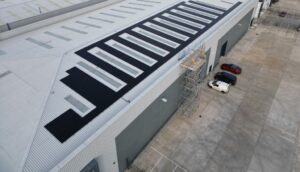
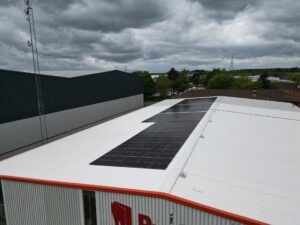
At Integra Buildings in Paull, East Yorkshire we installed a 257 kWp rooftop array with 220 kW of inverter capacity on a profiled industrial roof. It powers the manufacturing site directly, and the case study records 36% grid independence. Because the power is used on the premises, this is the kind of system the exception was written for. The panels, inverters and associated plant shouldn’t be counted in the site’s rateable value before April 2035.
Scotland and Northern Ireland
SI 2022/405 applies to England, and the VOA says equivalent treatment has applied in Wales since 1 April 2024.[1][2] Scotland and Northern Ireland run their own non-domestic rates systems with different reliefs. If your premises are there, check with the local assessor or rating authority rather than relying on this guide.
What you need to do
There’s normally no application form, because the rule changes how the VOA values your property, not your bill. Even so:
- Keep your handover pack. Keep the MCS certificate, the G99 or G98 notification and the single-line diagram. They show what was installed and that it’s connected behind your meter.
- Check your next rates bill and valuation notice. If your rateable value goes up and the only change was solar or a battery, use the VOA’s Check, Challenge, Appeal service through your business rates valuation account.[3]
- Tell your rating adviser if you have one. Large estates often have a surveyor managing their rating list entries.
- Keep export in proportion. If you’re planning a much larger array to export most of its output, ask about rates before you design it.
FAQ
Do solar panels increase business rates?
Not in England or Wales, while the power is used mainly on your premises. SI 2022/405 excludes that plant from rateable value until 1 April 2035, and Wales has applied the same since 1 April 2024.[1][2]
Is battery storage exempt from business rates too?
Yes. The exception covers plant for the storage of power from renewable sources, as well as generation.[1]
Does the exemption apply to solar farms?
Not to farms that mainly export. The VOA says plant that mainly exports power keeps its existing rating treatment.[2] A farmer’s array powering the farm’s own buildings is a different case from a field-scale export farm.
What happens after 2035?
The current exception applies to days before 1 April 2035.[1] Nothing has been announced about what follows, so treat any post-2035 saving in a financial model as an assumption.
Do I need to apply for the exemption?
Usually not. It changes how the VOA values the property. If your valuation goes up after an install, challenge it through the VOA’s Check, Challenge, Appeal service.[3]
Talk to us about your site
We’re an MCS-certified commercial installer based in Beverley, East Yorkshire. We design systems around your half-hourly data so that most of the power is used on site, which is what the rates exception assumes. Send us 12 months of bills or half-hourly data and we’ll model a system and its payback.
Book a free survey · Call 01482 765063
This guide explains the rules in general terms and isn’t tax or rating advice. For your own premises, speak to a qualified rating surveyor or the VOA.
Sources
- The Valuation for Rating (Plant and Machinery) (England) (Amendment) Regulations 2022, SI 2022/405: https://www.legislation.gov.uk/uksi/2022/405/made (checked 19 Oct 2026)
- VOA Rating Manual, section 6 part 3, Power generators: “Generation of power for on-site consumption” (SI 2022/405, and Wales SI 2023/1229 from 1 April 2024): https://www.gov.uk/guidance/rating-manual-section-6-part-3-valuation-of-all-property-classes/power-generators (checked 19 Oct 2026)
- GOV.UK, Business rates valuation account (used to check, challenge and appeal a valuation): https://www.gov.uk/business-rates-valuation-account (checked 19 Oct 2026)