Last updated 27 October 2026 · BrightEdge Solar team
Short answer: Yes, but not by fixing panels straight onto the asbestos cement sheets. HSE says asbestos cement roofs are always fragile and can’t bear weight, and its guidance asks whether you can overlay the sheets with non-asbestos material fixed to the existing purlins, avoiding drilling through the asbestos.[1] That’s our approach: we overclad the roof with new profiled sheeting and fit the solar on top, as one job. The other options are to remove the old sheets and re-roof, or to put the array somewhere else.
Asbestos cement roofs are common on older farm sheds, stores and warehouses across East Yorkshire. They’re often big and unshaded, so they look ideal for solar. This guide covers how to tell what you’ve got, why we never fix panels directly onto asbestos, and your three options.
Key facts
- Assume asbestos in older buildings: if a building was built or refurbished before 2000, HSE says to assume there’s asbestos in it.[4]
- Asbestos cement is fragile: HSE’s asbestos task sheet says asbestos cement roofs are “always fragile and cannot bear weight”.[1] Falls through fragile surfaces, particularly fibre-cement roofs and rooflights, account for 22% of fall-from-height deaths in construction.[6]
- Overlay rather than drill: HSE’s guidance is to overlay asbestos cement sheets with non-asbestos material attached to the existing purlins where you can, and to avoid drilling through the asbestos.[1][2]
- Removal is usually non-licensed work, done by workers trained in asbestos. It becomes notifiable if the sheets are likely to break up significantly.[3]
- Asbestos waste is hazardous waste when it contains more than 0.1% asbestos. It needs a consignment note and a licensed disposal site.[8][9]
How to tell if your roof is asbestos cement
Asbestos cement is ordinary cement mixed with asbestos fibres, sometimes more than a third of the mix. It’s a hard grey material that was pressed into profiled roof sheets, wall cladding, gutters and downpipes, often on warehouse-type buildings.[3] Modern fibre-cement sheets look very similar, so you can’t tell by eye.
- Check the asbestos register. For non-domestic buildings, the owner or whoever is responsible for maintenance has a legal duty to manage asbestos, including keeping a record of where it is and its condition, and telling anyone who might disturb it.[11] Ask for it when you ask for a solar quote.
- Get a sample tested. Bulk identification by a competent analyst confirms whether a sheet is asbestos cement.[3]
- Know which survey you need. A management survey covers normal use and maintenance. Work that breaks into the building fabric needs a more intrusive refurbishment or demolition survey before it starts.[4][5]
- Don’t go up to look. HSE warns owners not to walk on fragile material such as asbestos cement roofs.[4] In farming, roughly half of the deaths and serious injuries caused by falls involve work on fragile roofs.[7]
If the sheets turn out to be modern, non-asbestos fibre cement, the picture changes. Once we’ve checked their condition, we can usually fit panels to them directly.
Why we don’t fix panels straight onto asbestos
A solar array is fixed to the roof and stays there for decades. On an asbestos cement roof, that means:
- drilling or cutting the sheets, which disturbs asbestos and has to be done under HSE’s controls for drilling asbestos cement[2]
- people working on a fragile surface to fit, inspect and maintain the array[6]
- tying a long-life array to an old roof that may need replacing first
So we don’t do it. We overclad the roof and fit the solar to the new sheeting, or we look at the other options below.
Your three options
| Option | What it involves | When it suits | Watch out for |
|---|---|---|---|
| 1. Overclad, then fit solar | New profiled sheeting is fixed over the old roof, back to the existing purlins. The solar goes on the new sheets. The asbestos stays in place, covered.[1] | The structure is sound and you want to avoid removing the asbestos | The asbestos is still in the building, so it stays on your asbestos register. The frame must carry the new sheets plus the panels |
| 2. Remove and re-roof | The asbestos sheets come off and go to a licensed disposal site as hazardous waste. A new roof goes on, then the solar.[8][9] | The roof is near the end of its life, leaks or is damaged | Removal has to follow HSE’s asbestos guidance. If the sheets are likely to break up significantly, the work must be notified[3] |
| 3. Put the solar somewhere else | Use another roof on the site or a ground-mounted array, and leave the asbestos roof alone | There’s a better roof or spare land nearby | Longer cable runs and possibly more groundwork |
Option 1: overcladding
HSE’s asbestos task sheet suggests overlaying the old sheets with non-asbestos material attached to the existing purlins, and avoiding drilling through the asbestos where possible. Where drilling can’t be avoided, HSE’s sheet a9 sets out the controls.[1][2]
We plan the new sheeting, fixings and panel layout together, so it’s one design and one job. We’ll check the purlins, the frame and any rooflights at survey. On larger systems, we arrange a structural assessment.
Option 2: removing the asbestos and re-roofing
If the roof is tired anyway, replacing it can be the better long-term answer: a sound roof under the array, and no asbestos left in the building.
HSE says work on asbestos cement products should be done by non-licensed workers who are trained to recognise and work safely with asbestos. Removal that’s likely to cause significant break-up, such as dropping an asbestos cement roof, must be notified. Where the sheets are very badly damaged, a risk assessment decides whether a licensed contractor is needed.[3] HSE’s guidance is to avoid breaking the sheets, and to lower large pieces to the ground rather than dropping them.[1]
Asbestos waste over 0.1% asbestos is hazardous waste. It needs a consignment note, a registered carrier and a licensed disposal site. HSE says to keep the paperwork for three years.[8][9] Asbestos construction materials go to a hazardous waste landfill, or to a separate cell at a non-hazardous landfill.[9]
Option 3: solar somewhere else
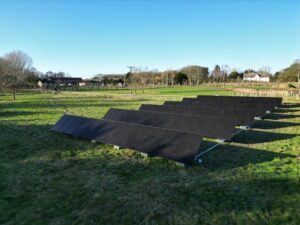
Sometimes it’s best to leave the asbestos roof alone and use a newer shed or a ground mount. At Wapplington near Pocklington, we installed a ground-mounted array on ballasted mounts, which need no piling or concrete foundations.
Check the structure and safe access first
Whatever you choose, these checks come before any panels:
- Purlins and frame. Old timber purlins can rot where a roof has leaked. HSE describes a fall where a decayed purlin probably fractured under the roof sheets.[7] We check the frame can carry the new sheeting and the array.
- Safe access. HSE’s order is avoid, control, communicate: work from below or from a platform where you can, and use stagings, guard rails, nets and fall arrest where you can’t. Warning notices go at the approach to any fragile roof.[6] Never walk along the line of the purlin bolts.[7]
- Rooflights. Old rooflights are often fragile too.[6] We design around them and protect them while we’re working.
- Asbestos information. Share your asbestos register and survey with us early, ideally when you ask for a quote.[11]
Planning and grid connection
In England, most rooftop solar on non-domestic buildings is permitted development under Part 14, Class J. There are limits: for example, panels on a pitched roof can’t stick out more than 0.2 m from the roof slope, and listed buildings are excluded. Larger systems (other solar PV on a roof, beyond microgeneration) need you to ask the planning authority whether it wants prior approval of the design or appearance, including glare.[10]
Most commercial and farm systems also need G99 approval from the network operator, which typically adds 8–12 weeks. See our G99 application timeline.
What it costs
Overcladding asbestos roofs, re-cladding and ground mounting are priced after survey. Every quote lists equipment, installation, scaffolding and DNO costs separately. For typical solar prices by system size, see how much commercial solar costs. Farm funding options are on our farm grants page.
In practice: re-clad and solar as one job at Little Habton
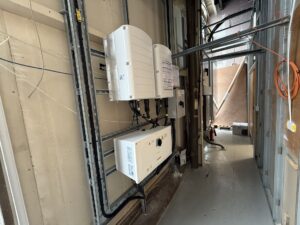
At Little Habton near Malton, a farm had an old agricultural store with a tired roof that was coming to the end of its life. We planned the re-clad and the solar as one project, so the new sheeting, fixings and panel layout all worked together. The store was re-clad in trapezoidal sheeting, then we fitted a 24.64 kWp array with a Fox ESS hybrid inverter and modular battery storage. As a commercial install, it’s covered by our 24-month workmanship warranty, as well as the manufacturers’ product warranties.
When it doesn’t stack up
- The frame won’t carry it without major strengthening.
- The building is due to come down in the next few years.
- The building uses little power in the day and there’s nowhere else on site to use it. A battery can help, but not always.
- The building is listed, so it falls outside Class J permitted development.[10]
Frequently asked questions
Can you put solar panels on an asbestos roof?
Yes, but not fixed directly to the asbestos sheets. We overclad the roof with new profiled sheeting and fit the solar on top, as one job. Other options are removing the sheets and re-roofing, or putting the panels on another roof or the ground.
Is it safe to drill into an asbestos cement roof to fit solar panels?
HSE’s guidance is to avoid drilling through asbestos cement where you can, and to overlay it with non-asbestos sheeting fixed to the existing purlins. Where drilling can’t be avoided, HSE sets out specific controls. We don’t fix panels straight onto asbestos.
Do I need an asbestos survey before installing solar?
If the building was built or refurbished before 2000, assume there’s asbestos. Non-domestic owners should already have an asbestos register. Work that breaks into the building fabric needs a refurbishment or demolition survey before it starts. Share whatever you have when you ask for a quote.
Do I have to remove an asbestos roof before fitting solar?
No. Overcladding leaves the asbestos in place, covered by new sheeting, and the solar goes on the new sheets. The asbestos stays on your asbestos register. If the roof is near the end of its life, removing it and re-roofing can be the better long-term choice.
Get your roof checked
Send us the address, a recent electricity bill or half-hourly data, and any asbestos survey or register you have. We’ll check the roof, structure and supply, then talk you through overcladding, re-roofing or another location.
Book a free survey · Call 01482 765063
Sources
- HSE, Asbestos essentials task sheet a14: Removing asbestos cement (AC) sheets, gutters etc and dismantling a small AC structure: https://www.hse.gov.uk/pubns/guidance/a14.pdf (checked 27 Oct 2026)
- HSE, Asbestos essentials task sheet a9: Drilling holes in asbestos cement (AC) and other highly bonded materials: https://www.hse.gov.uk/pubns/guidance/a9.pdf (checked 27 Oct 2026)
- HSE, Locations of asbestos and taking the right action (asbestos cement products): https://www.hse.gov.uk/asbestos/location-materials.htm (checked 27 Oct 2026)
- HSE, The duty to manage asbestos in buildings: Find out if asbestos could be present in your building: https://www.hse.gov.uk/asbestos/duty/is-asbestos-present.htm (checked 27 Oct 2026)
- HSE, The duty to manage asbestos in buildings: Arrange an asbestos survey: https://www.hse.gov.uk/asbestos/duty/arrange-asbestos-survey.htm (checked 27 Oct 2026)
- HSE, Fragile surfaces: https://www.hse.gov.uk/construction/safetytopics/fragile.htm (checked 27 Oct 2026)
- HSE, Falls through fragile roofs (agriculture): https://www.hse.gov.uk/agriculture/experience/falls-fragile.htm (checked 27 Oct 2026)
- HSE, Asbestos essentials sheet em9: Disposal of asbestos waste: https://www.hse.gov.uk/pubns/guidance/em9.pdf (checked 27 Oct 2026)
- GOV.UK, Hazardous waste: consignment notes: https://www.gov.uk/dispose-hazardous-waste/consignment-notes and Dispose of waste to landfill: https://www.gov.uk/guidance/dispose-of-waste-to-landfill (checked 27 Oct 2026)
- legislation.gov.uk, The Town and Country Planning (General Permitted Development) (England) Order 2015, Schedule 2, Part 14, Class J: https://www.legislation.gov.uk/uksi/2015/596/schedule/2/part/14/crossheading/class-j-installation-or-alteration-etc-of-solar-equipment-on-nondomestic-premises (checked 27 Oct 2026)
- HSE, The duty to manage asbestos in buildings: Overview: https://www.hse.gov.uk/asbestos/duty/index.htm (checked 27 Oct 2026)